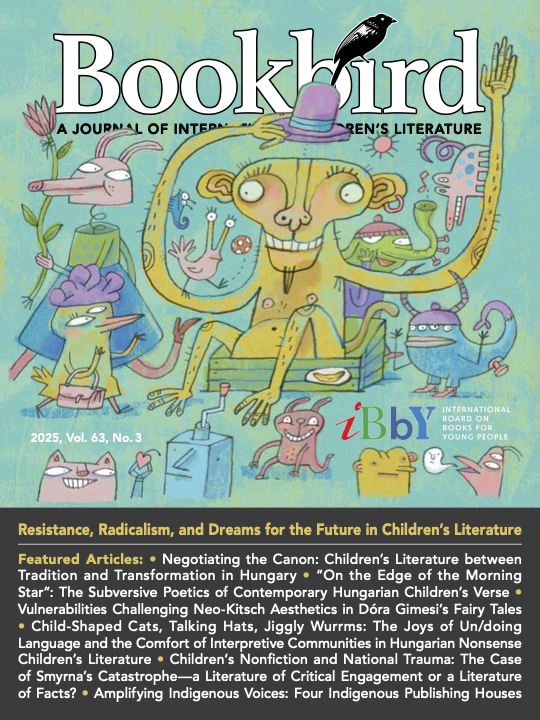

Bookbird 3 / 2025
Bookbird: A Journal of International Children’s Literature, Vol. 63, No. 3, 2025
Resistance, Radicalism, and Dreams for the Future in Children's Literature
One of Bookbird’s most important roles is to introduce and discuss children’s and young adult literatures from different parts of the world. This especially true for books from those regions outside English and other world language areas. Those of us in these areas are considerably advantaged in having so many high-quality publications available to us, but we also are disadvantaged in that we miss so much from countries whose languages, and consequently literature, is not widely spoken or read outside their borders.
This issue of Bookbird highlights books from Hungary for young readers. Articles discuss texts which may be regarded by the state as subversive, both historically and in the present day. Readers in other regions may recognize the circumstances which shaped these books and the circumstances of their publication, giving Bookbird readers an insight into a culture and creative processes which may or may not align with their own, but in any case will open doors to another world.
A modern-day publishing house which, like many others across the globe had small beginnings in a bookshop features. Now it brings not only Hungarian texts to young readers but also those from many other languages and cultures in translation. Humour in children’s books is a keynote value in their publishing portfolio, and in another article in this issue of Bookbird highlights Hungarian nonsense literature, emphasizing absurdity and linguistic play.
Indigenous publishing houses in Australia, Canada and the USA and their picturebook publishing strategies also feature in an article on indigenous voices, while other articles include one on Nonfiction and National Trauma in Greek children’s books.
Regular features include our ‘Letters’ section and this issue carries a short article on book banning, perhaps reminding readers of some of the issues arising in the articles from Hungary. This is the first in a series on banning and censorship, historical and present day, and the effects of these practices on children’s and young adult literature. We are encouraging a response from our readers to this topic.
Issue 63.3 also features the popular postcards which are interspersed throughout the issue and the ‘Books on Books’ section carrying reviews of international books about young people’s reading.
Keep informed about international children’s literature with Bookbird.
Subscribe to Bookbird
Download articles on Project Muse
| |
Resistance, Radicalism, and Dreams for the Future in Children’s Literature | by by Anna Kérchy and Chrysogonus Siddha Malilang | 1 |
| |
Negotiating the Canon: Children’s Literature between Tradition and Transformation in Hungary | by Ágnes Hansági | 4 |
“On the Edge of the Morning Star”: The Subversive Poetics of Contemporary Hungarian Children’s Verse | by József Lapis | 12 |
Vulnerabilities Challenging Neo-Kitsch Aesthetics in Dóra Gimesi’s Fairy Tales | by Gabriella Ágnes Nagy | 23 |
Child-Shaped Cats, Talking Hats, Jiggly Wurrms: The Joys of Un/doing Language and the Comfort of Interpretive Communities in Hungarian Nonsense Children’s Literature | by Anna Kérchy | 34 |
Children’s Nonfiction and National Trauma: The Case of Smyrna’s Catastrophe—a Literature of Critical Engagement or a Literature of Facts? | by Chryssa Kouraki | 47 |
Amplifying Indigenous Voices: Four Indigenous Publishing Houses | by Maria Scaletti, Julie Barbour, Nicola Daly, and Nicholas Vanderschantz | 57 |
| |
Contemporary Hungarian Children’s Literature and the Pagony Publishing House | by Eszter Kovács and Hanna Győri | 70 |
| |
“Being Banned Is Not an Award” | by Philip Nel | 76 |
Variations on a Theme: Csimota’s Wordless Fairy Tale Picturebook Pentalogy Series | by Emese Révész | 80 |
|
|
| |
|
|